The Store That Never Sold Anything Is Now the Town's Biggest Attraction
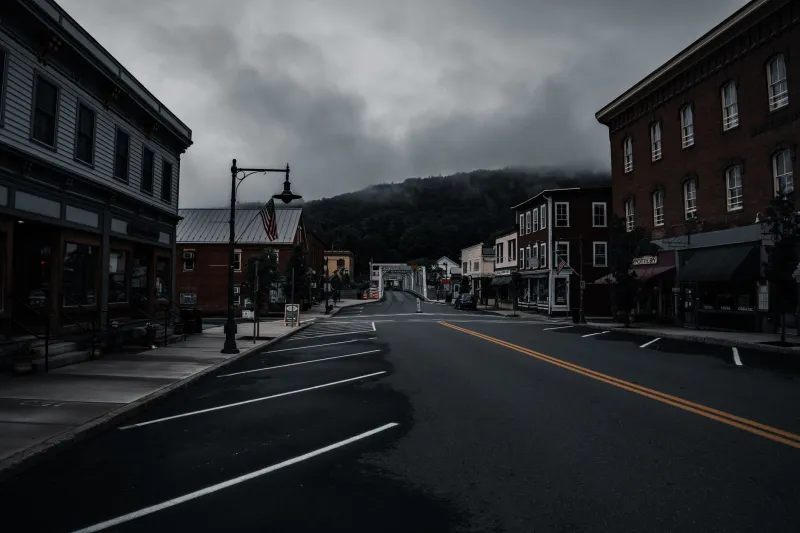
There's a storefront in a town of about 2,400 people somewhere in the Midwest that has a hand-painted sign, a window display of vinyl records, and a working bell over the door. It has never sold a single record. It was built in nine days in 2019 for a movie that spent four of those days shooting there, and when the trucks pulled out, nobody took it down.
In 2026, it's the most photographed building in the county.
This is not a one-off. All over the country, small towns are quietly maintaining bits of fake America — a diner counter, a police station lobby, a corner store with a name that doesn't exist in any business registry — because a film or TV crew needed it once and the town decided, for reasons both sentimental and financial, that it was worth keeping.
The plywood that refused to leave
The economics of leaving a facade standing are strange and specific. Sets built for exteriors are usually cheap by Hollywood standards and expensive by small-town standards. Take it down and you're paying a crew to haul away lumber. Leave it up and you're paying, eventually, for paint, rot, and the slow war between plywood and weather.
Most towns that keep them do it for a reason that has nothing to do with art. A fake storefront is a free photo backdrop. It's a story you can tell at a gas station. It's the difference between "we're the town with the water tower" and "we're the town where that thing was filmed."
And in the last few years, that difference has gotten easier to monetize. A pinned location in a maps app, a hashtag, a few thousand short videos of people posing in front of a door that leads to a wall of insulation foam — that's real foot traffic. Small tourism boards have noticed.
How a set becomes a landmark
The transition from "temporary" to "protected" is rarely official. Usually it happens in stages. First the production wraps and leaves behind a few dressing pieces. Then someone repaints the sign because it's peeling and looks bad. Then a local historical society, which normally handles buildings from the 1800s, gets a call asking whether it can also handle a fake pharmacy from a streaming drama.
By the time anyone thinks to ask whether it should be on a preservation list, it already functions as one. There are annual events now. A fall festival with a photo booth. A 5K that starts and ends at the fake diner. A Facebook group with a name that includes the year the show premiered.
The weird part is that the building often has no interior. You can see the front, the porch, the trim, and then — if you peek around the side — a wooden skeleton and a whole lot of daylight. Visitors describe the moment they realize it's a shell as part of the experience. It's a magic trick that only works once, and every tourist gets to have it.
The politics of the afterlife
Here's where it gets messy. A movie doesn't just pass through a town; it borrows the town's face and gives it back with a new name. Once that name sticks, locals have to fight over what it means.
Some residents love the attention. Others point out that the fake storefront sits on a lot that could be a parking garage, or that the town is spending maintenance money on a prop while actual Main Street three blocks over has empty windows. Both arguments are reasonable, which is why the arguments never end.
Then there's the studio question. Who owns the design? Usually the production does, at least on paper. In practice, almost nobody cares enough to send a letter. But occasionally someone does — a legal notice about trademarked signage, a request to not sell merchandise with the fictional name, a quiet negotiation over whether a town can put the fake logo on a coffee mug. These disputes are small and deeply unglamorous, and they tend to resolve with a handshake and a disclaimer on a T-shirt.
The ritual of the revisit
What keeps these places alive isn't the original film. It's the return trip. People who watched a show years ago drive out of their way to stand in front of a building that appeared on screen for ninety seconds. They take the same photo everyone takes. They buy a coffee from a real shop nearby, which is the actual economic engine of the whole thing.
There's a ritual to it. You park. You walk up. You notice the fake brick is a printed panel. You feel a small, pleasant disappointment, and then you take the photo anyway, because the point was never the brick. The point was being there.
Some towns lean in hard. They print maps. They leave a clipboard for signatures. Others go the opposite direction and act like it's nothing, which is its own kind of performance — the local who shrugs at the thing people flew in to see.
What it costs to keep pretending
Maintenance is the unglamorous core of this whole phenomenon. Paint fades. Wood warps. A facade built for a four-week shoot was never designed to survive fourteen summers of humidity and one hailstorm. Towns that have kept theirs for years have usually rebuilt it at least once, often with volunteer labor and a donation jar.
The smart ones have started treating it like any other piece of civic infrastructure — a budget line, an inspection schedule, a plan for what happens when it finally falls apart. The less smart ones wait until a corner sags and then hold an emergency meeting.
The 2026 twist: your phone is in on it
What's changed this year isn't the buildings. It's the discovery. Facades that used to be known only to superfans now show up as "points of interest" in mapping apps, tagged by users, reviewed like restaurants. Some have more reviews than the actual diner down the street.
That has sped up the cycle dramatically. A facade can go from local curiosity to regional day-trip destination in a single season, which is great for the coffee shop and stressful for the neighbor whose driveway becomes a turnaround.
It also means the afterlife of a movie is now partly managed by strangers with phones — people who never met the crew, never watched the shoot, and have no stake in the town except a photo. Whether that's a gift or a slow-motion invasion depends entirely on which side of the fake police station you live on.
Go see the nothing
If you're driving past one of these this year, it's worth the stop. Not because it's impressive, but because it's a rare, honest thing: a piece of pretend that a real place decided was worth keeping. It's plywood and paint and a whole town's complicated feelings about being briefly famous.
Stand in front of it. Take the photo. Buy something from a real business while you're there. And when you notice the brick is printed, enjoy it — that's not the illusion breaking. That's the whole point.